Stop Calling It Research

Tyler
Co-Founder & CEO

Most strategy content is anesthesia. It numbs the pain of not choosing. If you've explained the same problem three times and nothing moved, you don't have a thinking problem. You have a courage problem with better vocabulary.
Research isn't the villain. Research is how you stop shipping superstition. You talk to customers. You read the contract. You look at the cohort that actually retains. You sit with the engineer who's been trying to tell you the architecture won't survive the next ten customers. That's adult work, and it changes what you do next.
The problem starts when the research never ends. You keep collecting. You restate the options in new words. You find one more person to "pressure test" a call you already made in private. At that point you aren't learning. You're mentally masturbating. It feels rigorous because it uses the same muscles as real thinking. It produces notes, frameworks, and a feeling of seriousness. It does not produce a different Tuesday.
Research that changes a bet is work. Research that protects a bet from ever having to lose is stalling.
This Isn't a Small, Personal Habit. It's Expensive
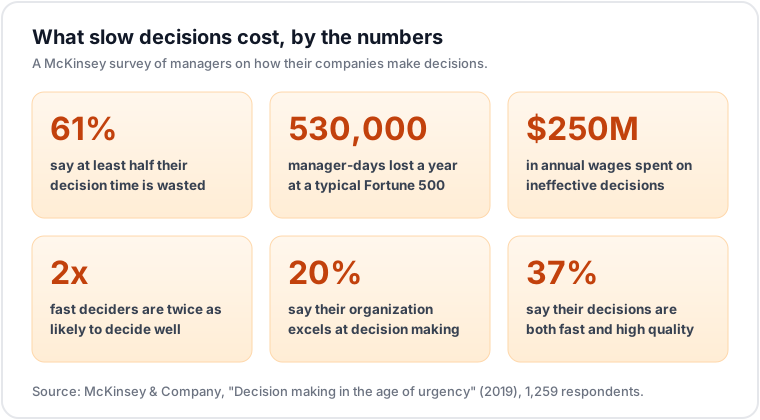
McKinsey surveyed 1,259 managers about how their companies make decisions. Most of them spend a big chunk of the week on it, and 61% said at least half of that time is used ineffectively. For a typical Fortune 500 company, McKinsey put the waste at more than 530,000 days of managers' time a year, roughly $250 million in wages.
And the part that kills the "I'm just being careful" defense: companies that decide quickly were twice as likely to make high-quality decisions as slow ones. Speed and quality aren't a trade. The slow shops aren't buying accuracy with their delay. They're just slow.
Prioritization vs. Stalling
People prefer the softer sentence: "We all struggle with prioritization." It's true the way "we all get tired" is true. It's also a fog machine.
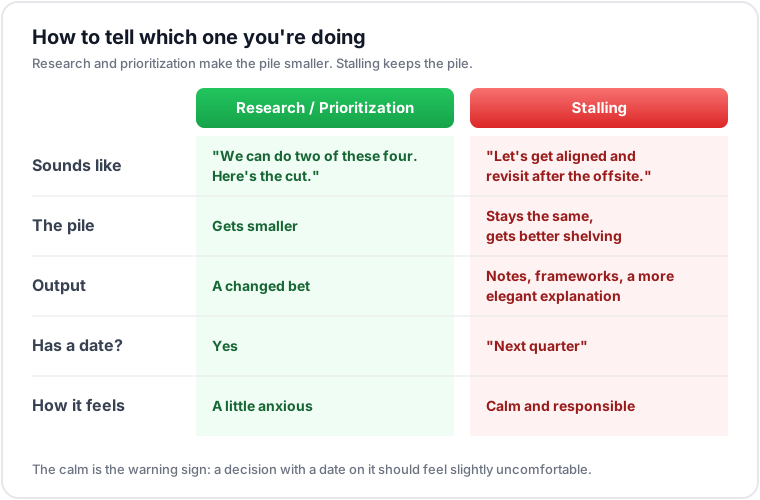
Prioritization problems are usually inventory problems. Too many good ideas, not enough hours, a calendar that's full. Stalling is different. Stalling is when the inventory is already on the table and you still won't pick the thing that dies.
You can hear the difference. Prioritization sounds like: we can only do two of these four, so here's the cut. Stalling sounds like: let's run one more pass, get aligned, wait until after the offsite, see how Q4 shapes up, keep both options open. Prioritization makes the pile smaller. Stalling keeps the pile and buys nicer shelves to store the bad ideas on.
I've done both. The second one is more common among people who think of themselves as thoughtful, because thoughtfulness makes a great crutch. You're not afraid, you're being careful. You're not hiding, you're "making sure." Meanwhile the draft ages. The candidate cools. The feature keeps its champion and the customers keep suffering. The market doesn't grade your process. It grades the week you finally stopped rehearsing.
Not Choosing Is Still a Choice. It Just Hides the Author
The hire you won't make is a choice to keep the seat empty and pile the work on people who already have jobs. The feature you won't kill is a choice to keep spending design, support, and attention on something you already distrust. The post you won't ship is a choice to stay the person with something "in the works."
Teams pay for that. They can't plan around a maybe. They start hedging. They stop bringing you the sharp version of the problem, because the last three sharp versions went into another round of research. Indecision doesn't stay in your head. It leaks into the people waiting on you.
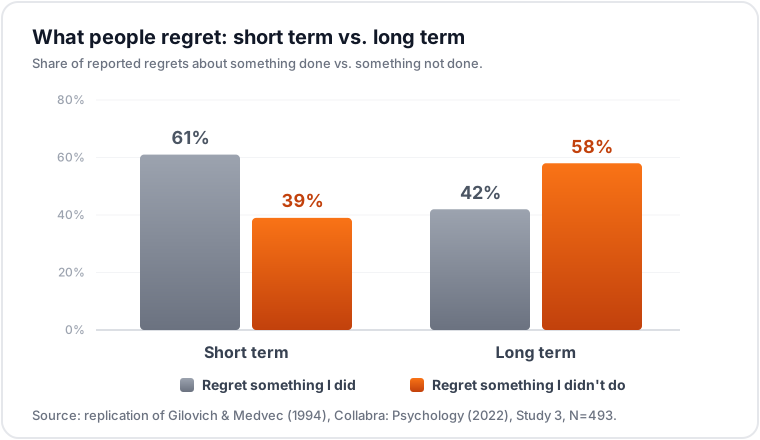
It also leaks into you, later. Psychologists Thomas Gilovich and Victoria Medvec found that in the short run we regret the things we did, but over the long run we regret the things we didn't do. A 2022 replication with nearly 500 participants landed in the same place: action dominates short-term regret, inaction dominates long-term regret.
Focus Means Putting a Date on the Bet You Think Is Wrong
Focus isn't a calendar trick. Focus is accepting that one of your current bets is wrong and putting a date on it.
That sentence is most of this post. A date turns a preference into a decision. Without one, "we might win" is just a story you tell so you can keep funding it. "We're still evaluating the role" means you like the optionality of a person who doesn't work there yet. "The blog isn't ready" means you want the credit of having something in motion without the risk of shipping something people can dislike.
Pay attention to what the date does to your body. Write "kill Feature X by Friday if activation doesn't move" and you feel a little anxious. That anxiety is information. It means the bet is real. Write "continue to monitor Feature X and revisit next quarter" and you feel calm and responsible. That calm is information too. You just extended a zombie with better words.
The 40 to 70 Rule: How Much Information Is Enough?
You don't need a new operating system for this. Serious operators already have the heuristics, when they aren't performing thoughtfulness.
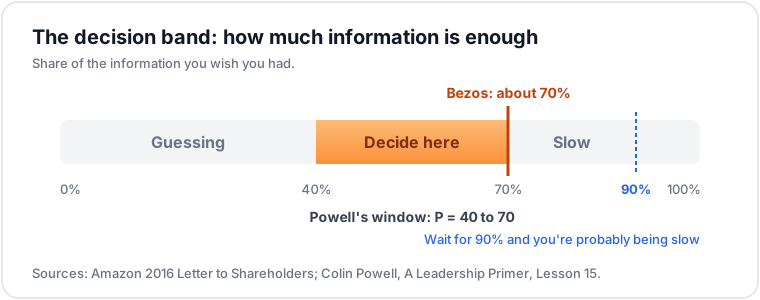
Jeff Bezos, in his 2016 Amazon shareholder letter: "Most decisions should probably be made with somewhere around 70% of the information you wish you had. If you wait for 90%, in most cases, you're probably being slow." He paired that with the point that most decisions are reversible, "two-way doors," and should get a lightweight process.
Colin Powell's version was blunter: P = 40 to 70, where P is your odds of being right and the numbers are the share of information you have. Under 40% and you're guessing. Wait past 70% and the window has usually moved.
Neither of them was arguing against research. They were arguing against the fantasy that one more slide removes the chance of being wrong.
Use the numbers as a smell test, not a religion. If you already have the customer quotes, the retention chart, and the person who'll have to live with the call, you're probably in the band. Another week of "alignment" won't get you from 70 to 90. It'll keep you safe while the team eats the uncertainty you wouldn't hold.
The Tell: You've Explained It Three Times
The most obvious tell is repetition. Explain the same problem to three different people. If the explanation gets more elegant and nothing in the world changes, you aren't improving. You're performing competence.
The third conversation usually gives it away. By then you have a polished narrative of the tradeoff. You can steelman it. You can do the "on the other hand." You could teach a class on the decision. You still haven't made it. That's not depth. That's delay with a whiteboard.
Why Smart People Do This
Not because they're missing a framework. Because a live decision carries a social cost that research doesn't.
If you choose, you can be wrong in a way people can point at. If you keep researching, you're "in process," which is a protected class in most companies and most friend groups. Process buys you patience. A bad call buys you a story about your judgment. So you keep the identity of the careful thinker and outsource the risk to time.
Time is a terrible partner. It doesn't keep your options fresh. It lets other people decide around you. Your team feels it first. Then your customers do.
There's a quieter reason, too. Some of the open loops aren't strategic. They're identity. Killing the feature means admitting you liked the idea more than the user did. Passing on the hire means giving up the colleague you'd pictured. Publishing the piece means you're no longer someone with "something in the works." You're someone who said a thing. That's a smaller, sharper risk, and a lot of research is just postponing it.
There's data on this, and it doesn't flatter the careful. Economist Steven Levitt had people who were stuck on a big decision (quit the job, end the relationship, go back to school) flip a coin on his site. Across more than 22,500 flips, people who got heads, meaning "make the change," were about 25 percentage points more likely to actually do it. Six months later, the people who made the change reported being substantially happier. His conclusion: people are probably too cautious about major life changes.
Levitt's Coin-Toss Experiment
- 22,500+ coin tosses from people stuck on a major decision
- About 25 points more likely to make the change when the coin said "change"
- Six months later, people who made the change reported being substantially happier
- The status quo was the choice people over-picked, according to Levitt
This Isn't Permission to Be Reckless
Reckless is the other monster. Reckless people hate dates too, just differently. They ship to avoid thinking. That's not you. You already think. Your failure mode is the tasteful pause.
The fix isn't "trust your gut." The fix is making research earn a change or get out of the way.
Two tests help.
Write down what would have to be true to keep waiting. After the last interview, the last customer call, the last reread, name the condition. Tell someone. If you can't write it down, you aren't waiting for information. You're waiting to feel like a person who can't be blamed. That feeling almost never shows up. You just get older inside.
Ask what you'd tell a friend. When it's not your company and not your draft, you're brutally clear. Pick one. The meeting is a substitute for action. Then you go back to your own desk and open another tab about decision-making under uncertainty. The gap between the advice you give and the loop you're stuck in is the prison.
Use Objects, Not Principles
If you want this to be practical without turning it into a kit, work with objects. A principle lets you nod. An object makes you flinch.
- The doc that's been "almost done" for six weeks.
- The role you can describe so well you could recite it, with no offer sent.
- The product surface that still has a Slack channel, a roadmap row, and a declining chart.
- The partnership you keep "exploring."
- The price change you've modeled four times.
Pick one. Not the symbolic one you'd put in a tweet. The one that would change the next two weeks if it died or went live. The people around that object are already living with your delay. You're not the only one in the sentence.
Then do the unfashionable part. Write the decision in one sentence a skeptic could understand. Not a memo. A sentence.
- "We are not hiring for this role in September."
- "We are shipping the essay Wednesday in its current form."
- "If activation is flat Friday, we pull the feature from the hero section."
The sentence needs a verb that ends something. If it still contains "continue," "explore," or "align," you wrote a puff piece.
Send it to the person who'll remember it on Friday. Not a group thread, where responsibility dissolves. One person. Someone who likes you enough to be honest and not enough to protect your delay. Their job isn't to approve your thinking. It's to notice if you flinch.
Then close the tabs.
That sounds like a punch line. It isn't. The tabs are the ritual. They let you feel like the decision is still being fed. Kill the ritual and you can finally make the call. You can go back to research when you have a new bet that needs it. Using reading to keep an old bet on life support just makes the funeral longer.
No Soft Ending
You'll want one. Something about progress over perfection, giving yourself grace, playing the long game. Grace is fine after you choose. Before you choose, grace is the outfit stalling wears. The long game is built out of dated bets, and you'll lose some of them in public. That's the job. The other version, endless inputs and no scars, is a hobby that looks like leadership.
Research until the world changes. If it doesn't, stop calling it research. Make the call that would embarrass you if it stayed unmade. Put a date on the bet you're willing to be wrong about. Then live with the sharp risk of someone who picked.
Been "evaluating" your cloud reliability exposure for a few quarters? The ROI calculator at nextsignal.io puts a number on it in under a minute, which is usually enough information to decide.
Frequently Asked Questions
How much information do you need to make a decision?
Jeff Bezos wrote in his 2016 Amazon shareholder letter that most decisions should be made with about 70% of the information you wish you had, and that waiting for 90% usually means you are being slow. Colin Powell's rule was to decide with between 40% and 70% of the information.
How do you know if research has turned into stalling?
Research is work when it changes a bet. It is stalling when it keeps restating the same options, when you've explained the same problem to three people and nothing moved, and when you cannot write down the specific condition that would end the waiting.
Do fast decisions hurt decision quality?
No. A McKinsey survey of 1,259 managers found that organizations that make decisions quickly are twice as likely to make high-quality decisions as slow decision makers.
Do people regret action or inaction more?
In the short term people regret actions more, but over the long term they regret inaction more. In a 2022 replication of Gilovich and Medvec's research, 58% of long-term regrets were things people didn't do.
Sources
Research and primary sources cited in this article:
- McKinsey & Company: Decision Making in the Age of Urgency (2019)
- Jeff Bezos: 2016 Letter to Amazon Shareholders
- Oren Harari: Quotations from Chairman Powell, A Leadership Primer (Lesson 15)
- Steven D. Levitt: Heads or Tails, The Impact of a Coin Toss on Major Life Decisions and Subsequent Happiness (NBER Working Paper 22487; Review of Economic Studies 88(1), 2021)
- Revisiting the Temporal Pattern of Regret in Action Versus Inaction: Replication of Gilovich and Medvec (1994), Collabra: Psychology 8(1), 2022