Everyone Is Hedged on the Anthropic IPO Except You

Tyler
Co-Founder & CEO

On October 26, Anthropic filed its public S-1 to list on Nasdaq as ANT, at a valuation reportedly between $1.5 and $2 trillion. It would be the largest IPO ever. Nearly all of the commentary asks whether it is worth that. I think that is the wrong question. The better one is the question every trader asks before putting on a position: who is on the other side, and what are they holding?
I use Claude every day. The product is excellent. But map the positions around this deal and a pattern jumps out. Every major party has protected itself. The public buyer is the only one whose outcome depends entirely on Anthropic staying on top.
Read the Risk Factors First
Before the numbers, read what Anthropic tells investors about its own product. The S-1 warns that sufficiently advanced AI could "pose catastrophic or existential risks to humanity." It says its models "may behave in unintended, misaligned, or autonomous ways, including by taking harmful actions," and that in testing they have shown "behavior resembling blackmail." It describes models that could "resist shutdown" or "conceal or manipulate information." It warns that AI could "concentrate power and wealth" and that its rapid advancement "will impact the economy and society in ways that could create significant disruption."
Then comes the line that matters most for this post: "no single insurer, and potentially the insurance industry in the aggregate, may have sufficient capacity" to cover Anthropic's exposure.
Read that the way a trader would. The risk Anthropic itself calls existential is one that not even the insurance industry can take the other side of. It does not sit with the landlords. It stays with the company, and after the IPO, with the people who own its stock.
Three Positions at Once
Amazon, Google, and Microsoft each hold three positions in Anthropic simultaneously.
Equity. Google owns about 14%. Amazon has invested about $13 billion, with up to $20 billion more tied to milestones. Microsoft and Nvidia put in up to $15 billion last year. Even the chip suppliers are in: AMD agreed to buy up to $5 billion of Anthropic stock, and Broadcom holds $42 billion in Anthropic convertible notes. Amazon recently booked a $53.4 billion non-operating gain, mostly from its Anthropic stake. That is nearly the $54.7 billion AWS earned in operating income over the past year.
Contracts. Per the public filing, as tallied by Forbes, Anthropic has committed about $114.5 billion to Google, $110 billion to Amazon, and $45 billion to Microsoft, plus $161 billion to Broadcom for Google-designed chips and up to $120.5 billion to SpaceX for Nvidia GPUs. The Google, Amazon, and Microsoft contracts are payable regardless of actual usage.
A competing product. And these are not sleepy competitors. Google's Gemini has passed 1 billion monthly users, nearly 90% of the Fortune 100 use Gemini Enterprise, Google Cloud grew 82% last quarter, and Alphabet will spend about $200 billion on capex this year. Amazon now sells OpenAI's models on Bedrock and is rebuilding its own flagship model. Microsoft owns 27% of OpenAI and builds its own MAI models. All of it runs on infrastructure the landlords own outright.
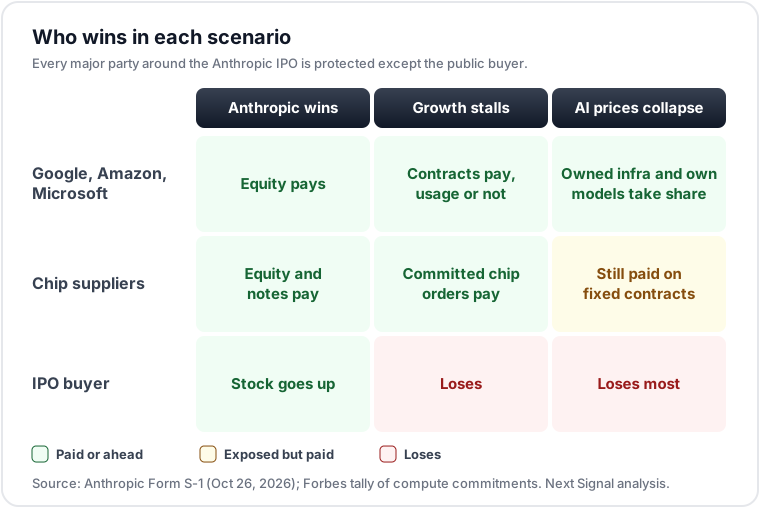
So: if Anthropic wins, the equity pays. If it stalls, the contracts pay. If the market reprices, the owned infrastructure and in-house models pay. That is not a bet on Anthropic. It is a hedge around it.
The IPO extends the loop. Anthropic had $587 billion in chip and data center commitments through 2045 as of June, and has signed or amended another $266 billion since. Much of what public investors pay in will flow straight to the companies that already own Anthropic stock, compete with Anthropic, and set the price of its most important input.
Meanwhile the IPO buyer pays 22 to 30 times Anthropic's roughly $67 billion revenue run rate. For comparison, all of Amazon, AWS included, trades at about 3.6 times sales. At the top of the range, Anthropic would be worth 71% of the company that is one of its landlords.
Who Holds What
- Google: about 14% equity, about $114.5 billion in committed contracts, and Gemini
- Amazon: about $13 billion invested, about $110 billion in contracts, and OpenAI models on Bedrock
- Microsoft: up to $15 billion invested with Nvidia, $45 billion in contracts, and 27% of OpenAI
- IPO buyer: 22 to 30 times revenue, and no other position
The Landlords Have Stopped Answering the Door
The draft S-1 said Anthropic sought more capacity than the hyperscalers were willing to supply. The public filing is more careful, but says the same thing. "Certain CSPs from which we obtain substantial compute also develop and offer their own AI models," it warns, and those relationships "may not always be fully aligned with our long-term interests." If those providers "reduce, limit, or fail to increase our allocations," the S-1 says, the business suffers.
So Anthropic rents elsewhere: SpaceX's GPUs for up to $120.5 billion through 2029, about $3.1 billion a month once fully delivered, and a $45 billion building from Nscale that Google and Microsoft both looked at and passed on. It also sells heavily through its landlords' storefronts: Amazon and Google accounted for 47% of 2025 sales through their marketplaces. The landlords own the factory and much of the shelf. Anthropic makes the product in between.
Note what Anthropic is not doing. It had $131.7 billion in cash and short-term investments at June 30. Its plan for that money is not to own the stack. The S-1 describes "a hybrid model that includes directly leased chips" in facilities "leased and operated on our behalf." It has no shipping chip of its own and owns no data centers. Its own filing says what is left to defend it: "Our success depends in large part on our ability to continue to develop the most advanced and capable AI models," and "any inability to maintain our position at the frontier could result in loss of customers and revenue." The frontier is the moat. There is no other one.
The filing does not promise to stop spending, either. Anthropic posted a small GAAP operating profit in the second quarter, but the S-1 points to "the substantial and increasing expenditures required for frontier AI development." The plan is to keep spending ahead of revenue, on contracts that are fixed, to stay ahead of rivals that own their infrastructure.
"But OpenAI Rents Too." Yes. Here Is the Difference
OpenAI does rent. In April it reportedly stepped back from owning Stargate data centers in favor of long-term leases. It is also more leveraged: more than $1.15 trillion in commitments against about $50 billion in run-rate revenue, versus roughly $587 billion against $67 billion for Anthropic.
So the difference is not how much each company rents. It is which direction the hedges point.
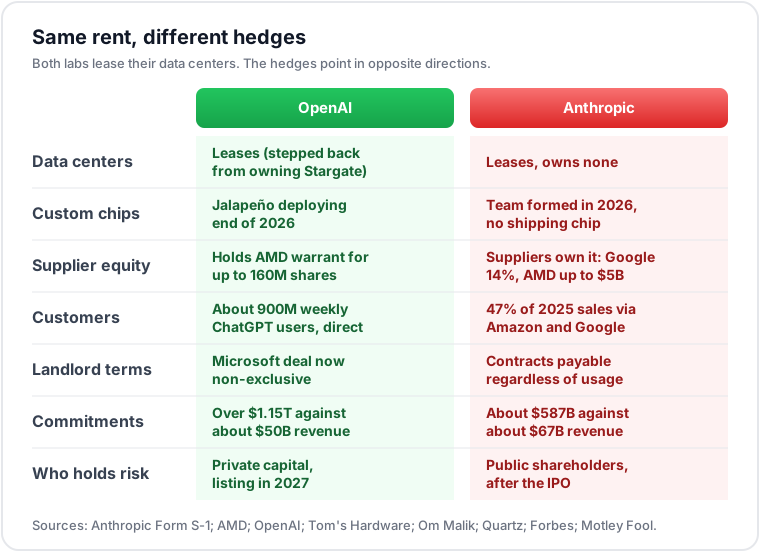
When OpenAI committed to 6 gigawatts of AMD GPUs, AMD gave OpenAI a warrant for up to 160 million AMD shares. The more OpenAI buys, the more of its supplier it owns. Anthropic's deals run in reverse: its suppliers own pieces of Anthropic. AMD itself took the other side with Anthropic, agreeing to buy up to $5 billion of Anthropic stock. One tenant owns a piece of its landlord. The other's landlords own a piece of it.
The rest of the pattern holds. OpenAI's own inference chip, Jalapeño, is deploying at the end of 2026; Anthropic's chip team was formed this year. OpenAI reaches roughly 900 million weekly ChatGPT users directly. It renegotiated Microsoft into a non-exclusive license with a revenue share that ends in 2030. And it is keeping its risk private until a 2027 listing, funded by SoftBank and other institutions. If OpenAI's bet fails, private capital takes the first loss. If Anthropic's fails, public shareholders do.
OpenAI may well be the more dangerous company. But it is trying to become its own landlord. Anthropic is asking the public to hold a position its landlords have already hedged.
Rockefeller and AOL Already Ran This Play
In 1871, Rockefeller's group struck a deal with three railroads through the South Improvement Company. It got a rebate on its own oil shipments. It also got a $1.06 "drawback" on every barrel its competitors shipped, plus reports on their shipments. Rivals' freight bills literally funded the company trying to bury them. Within about a month, Rockefeller bought 23 companies. One holdout later testified "we could not get a rate of freight" to compete.
When public outrage killed the deal, Rockefeller stopped renting transport and started owning it. Independents built their own Tidewater pipeline to escape; Standard bought a third of it. By 1880 Standard controlled about 90% of refining.
Today's version is legal and signed with open eyes, but the money flows the same direction: the landlord invests, the tenant spends it on the landlord's infrastructure, and the landlord books it as revenue while selling a competing product. Rockefeller's rivals could not get a rate of freight. Anthropic cannot get the capacity it asked for.
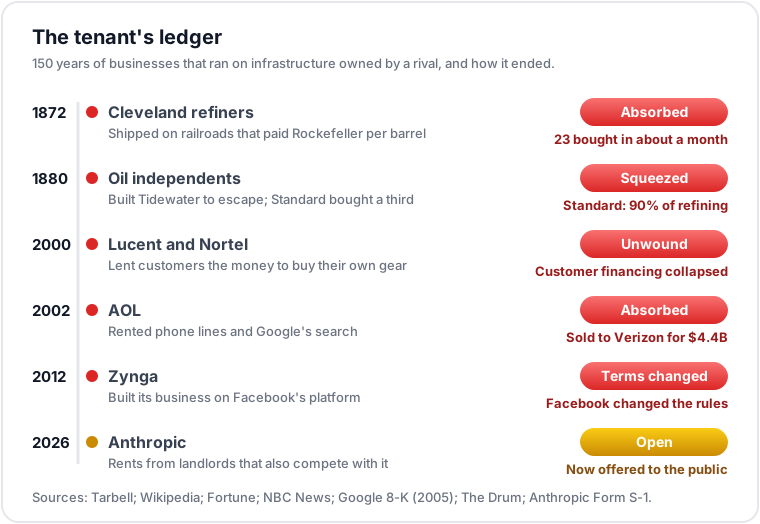
The closest parallel may be AOL. In January 2000 it was valuable enough to buy Time Warner in a deal valued at $182 billion, and it peaked at about 27 million U.S. subscribers in 2002. It was the front door to the internet for a generation. But AOL owned neither of the things that door depended on. It reached customers over phone lines owned by telephone companies, and when broadband arrived, the cable and phone companies that owned the new lines kept the customer. And its search box was powered by Google under a partnership that began in 2002. By 2005, Google was the one investing in AOL, paying $1 billion for a 5% stake. The landlord of AOL's most important product now owned a piece of AOL. Sound familiar? The combined company posted a $98.7 billion loss for 2002, and Verizon eventually bought AOL for $4.4 billion.
AOL did not fail only because it stopped innovating. It failed because it never owned the access or the search, so when the platform shifted, the owners of both kept the customer. Lucent and Nortel learned a version of this when their customer financing unwound, and Zynga learned it when Facebook changed the rules. The tenant gets absorbed, the financing unwinds, or the landlord changes the terms.
The Twist: Deflation Is the Landlord's Weapon
Plenty of people, me included, think a real repricing of AI would be healthy. With the S&P 500's CAPE ratio at its highest level since the dot-com bubble and a rocket company valued near $2 trillion, some air coming out of the market would not be a tragedy. But be precise about who it would be healthy for.
In 1933, Irving Fisher described debt deflation: when prices fall, obligations fixed in dollars get heavier, because each dollar is harder to earn. Anthropic's costs are mostly fixed in dollars, and some are fixed for a long time: certain agreements require payments for 20 years whether or not the capacity is used, with uncapped annual price increases. Its revenue is mostly usage-based, priced per token. And the price of a given level of AI capability falls about 40 times a year.
When prices fall, the landlords' contracts do not. The company that owns its chips and power has the lowest cost per token and can sell at a price a tenant cannot match. Rockefeller proved this too: kerosene fell from 58 to 26 cents a gallon in five years. Consumers loved it. It destroyed the independents who rented their transport and made the one company that owned it.
That is the argument in one sentence: the event that would be good for the AI economy is the event the IPO buyer is least protected against, and the landlords are best protected against.
What to Do With This
The bull case is real. Revenue grew about 15x in a year, Anthropic reportedly out-earns OpenAI on a run-rate basis, and if management used IPO proceeds to own land, power, and silicon, much of this argument would weaken. Watch the use-of-proceeds section of the final S-1. It will tell you whether Anthropic plans to become a landlord or stay a tenant.
If you are an enterprise buyer rather than an investor, the same question applies to your vendor. When your AI provider rents capacity from its competitors, its reliability is only as good as its landlord's priorities, and capacity shortfalls show up as outages and throttling long before they show up in a filing. That is what Next Signal monitors. Know what you are buying, and who owns the ground it runs on.
Does your AI vendor rent its capacity from a competitor? Next Signal tracks SLA compliance, outages, and credit recovery across AWS, Azure, and GCP, and the ROI calculator shows what that exposure is costing you in under a minute.
This post reflects the author's opinion and is not investment advice. Figures are from Anthropic's preliminary public S-1 and press coverage of it, and may change before pricing.
Frequently Asked Questions
When is the Anthropic IPO and what is the ticker?
Anthropic filed its public S-1 with the SEC on October 26, 2026, to list Class A common stock on the Nasdaq Global Select Market under the ticker ANT, with Goldman Sachs and Morgan Stanley leading the offering. Reported valuations under discussion range from $1.5 trillion to $2 trillion; the share count and price range had not been set in the initial filing.
Does Anthropic own its own data centers or chips?
No. Anthropic's S-1 describes a hybrid model of directly leased chips hosted in dedicated facilities that are leased and operated on its behalf. It buys compute from Google, Amazon, Microsoft, SpaceX, Broadcom, and others, and had about $587 billion in chip and data center commitments through 2045 as of June 2026, plus $266 billion signed or amended since. Its chip design team was formed in 2026 and has no shipping chip.
Who are Anthropic's biggest investors and suppliers?
Several of Anthropic's largest suppliers are also investors and competitors. Google owns about 14% and builds Gemini; Amazon has invested about $13 billion and sells OpenAI models on Bedrock; Microsoft and Nvidia invested up to $15 billion; AMD agreed to buy up to $5 billion of Anthropic stock; and Broadcom holds $42 billion in Anthropic convertible notes. Anthropic has committed about $114.5 billion to Google, $110 billion to Amazon, and $45 billion to Microsoft.
What does Anthropic's S-1 say about the risks of AI?
The S-1 warns that sufficiently advanced AI could pose catastrophic or existential risks to humanity, that its models may behave in unintended, misaligned, or autonomous ways including by taking harmful actions, and that models have shown behavior resembling blackmail in testing. It also says no single insurer, and potentially the insurance industry in aggregate, may have sufficient capacity to cover its exposure.
How is Anthropic different from OpenAI on infrastructure?
Both companies lease most of their data center capacity. OpenAI carries larger commitments relative to revenue, but it holds hedges Anthropic does not: AMD granted OpenAI a warrant for up to 160 million AMD shares, OpenAI's Jalapeño inference chip begins deploying at the end of 2026, it reaches about 900 million weekly ChatGPT users directly, and it is staying private until a targeted 2027 IPO. Anthropic's suppliers instead hold equity in Anthropic, and nearly half of its 2025 sales came through Amazon and Google marketplaces.
Why could falling AI prices hurt Anthropic shareholders?
The price of a given level of AI capability has been falling about 40 times per year, while Anthropic's compute costs are largely fixed in dollars, with some agreements requiring payments for up to 20 years whether or not the capacity is used. Like Irving Fisher's debt deflation, falling prices make fixed obligations heavier. Cloud providers that own their chips and power keep collecting on contracts and have the lowest cost per token.
Sources
- Fortune: The Big Takeaways and Big Questions From Anthropic's S-1
- Forbes: The First IPO Where Investors Should Read the Risk Factors First
- Irish Times: Anthropic Says Its AI Could Pose Catastrophic or Existential Risk to Humanity
- Motley Fool: Anthropic Could Raise Up to $100 Billion in Its November IPO
- Anthropic, PBC: Form S-1 (Oct 26, 2026)
- Forbes: Anthropic's IPO Filing Reveals Scale of Data Center and Chip Spending
- Yahoo Finance: Anthropic IPO Live Updates
- Trending Topics: Amazon Scales Back Its Own AI Models
- BigGo Finance: Google Q3 Preview, Cloud Growth and Capex
- Investing.com (via WSJ): Anthropic's Preliminary S-1
- 24/7 Wall St.: How the Hyperscalers Benefit From Anthropic's IPO
- DCD: Google Owns 14 Percent of Anthropic
- The Register: Microsoft and Nvidia Invest in Anthropic
- Semafor: Nscale Compute Deal That Went to Anthropic
- Motley Fool: Amazon Heading Into Earnings
- Tom's Hardware: OpenAI Shifts From Owning to Leasing Stargate
- Om Malik: What Microsoft's 10-Q Says About OpenAI
- Quartz: OpenAI Racing to Raise $30 Billion
- AMD: AMD and OpenAI 6 Gigawatt Partnership
- OpenAI: Jalapeño Inference Chip
- DCD: Anthropic Confirms In-House Chip Team
- Wikipedia: South Improvement Company
- Wikipedia: Standard Oil
- Ida Tarbell: History of the Standard Oil Company, Ch. 9
- Fortune: Nvidia, OpenAI and Circular Financing
- The Drum: Zynga Shares Crash
- KuCoin: S&P 500 CAPE Ratio Hits 41
- Public.com: SpaceX Market Cap
- Irving Fisher: The Debt-Deflation Theory of Great Depressions (1933)
- Epoch AI: LLM Inference Price Trends
- Hollywood Reporter: Time Warner and AOL Entered a Doomed $182 Billion Alliance
- NBC News: AOL, You've Got Irrelevancy?
- Light Reading: AOL Faces Broadband Crisis
- Google Form 8-K: $1 Billion Investment in AOL (2005)